Training space
Everything you own has to be housed somewhere, and there are two separate places to put things: training space for troops and vehicle bays for vehicles. You cannot build past either, and neither can ever spend the other — which matters most at the exact moment you are trying to grow.
What houses what
| Building | Pool | Level 1 | Level 2 | Level 3 | Max you can build |
|---|---|---|---|---|---|
| Barracks | Troops | 5 | 8 | 16 | 2 |
| Training Yard | Troops | 15 | 30 | 60 | 4 |
| Factory | Vehicles | 5 | 8 | 16 | 2 |
| Motor Pool | Vehicles | 15 | 30 | 60 | 4 |
The two military production buildings — Barracks and Factory — each carry a small garrison on purpose: enough to house what you have just learned to make, before you can afford the building that scales it. The Training Yard and the Motor Pool are the scaling levers, and because their space doubles per level, upgrading one is always worth more than a second at the same tier costs.
- Units in the queue count against the cap as well as units already standing. If they did not, you could queue five batches while under the limit and land far over it.
- Troops committed to a vehicle assembly still hold their bunks. They are locked, not spent, and the space is handed back only when the vehicle is delivered. See vehicles.
- Units out on an expedition still hold their place too. Nothing frees housing except a unit ceasing to exist.
Upgrading costs you the space while it runs
Starting an upgrade takes the building offline for the whole upgrade, and an offline building provides no housing. Upgrade your only Training Yard and your capacity drops by 15 immediately — you can end up at 35 / 5 with every unit greyed out as No room. The same is true of a Motor Pool and your vehicle bays.
Nothing is lost while this is happening. Your existing troops are fine, you simply cannot train more until the upgrade lands. There are three ways through it:
- Wait it out. Free, and the capacity comes back larger than it was.
- Build a second one first, then upgrade the first. Costs resources and takes a build timer, but nothing lapses and nothing expires.
- Raise a tent to cover the gap. Costs War Bonds, and it is standing immediately.
The four rented structures
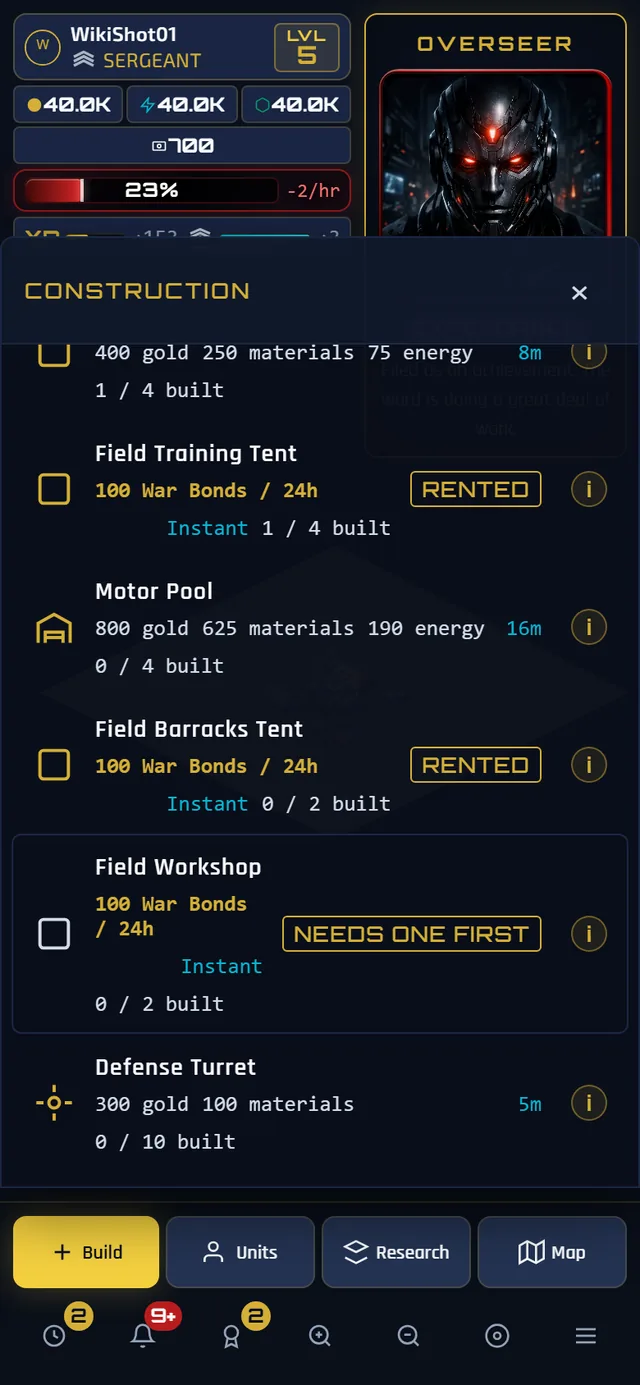
All four are the same deal: rented, not built. They cost no resources, take no build time, cannot be upgraded, and stand only as long as you keep paying for them. What differs is the job — and one of them does not do this page's job at all.
| Rented | Stands in for | What it does | Size | Needs | Per day | How many |
|---|---|---|---|---|---|---|
| Field Training Tent | Training Yard | Houses troops | 2×2 | Lvl 2 | 100 | 4 |
| Field Barracks Tent | Barracks | Trains infantry | 2×1 | Lvl 2 | 100 | 2 |
| Field Workshop | Factory | Assembles vehicles | 2×2 | Lvl 4 | 100 | 2 |
| Field Research Post | Nothing | Grants a second research line | 2×1 | Lvl 3 | 150 | 1 |
It houses nobody, it stands in for nothing, and none of the sizing below applies to it. What it sells is a permission — one more research project running at once — rather than room, which is why it is the only rented structure you can take without owning a particular building first, and why it is capped at one at a time. It is covered on research, where the thing it grants lives. Everything else on this page is about the three that house something.
The terms
A rental is bought by the term, and there are four. The day rate is the unit every price comes from; a longer term is billed as fewer day-rates than it lasts, so the longer you commit the less each day costs — down to half.
| Term | Billed as | Tent (100/day) | Post (150/day) | Saving |
|---|---|---|---|---|
| 1 day | 1 day | 100 · $1.00 | 150 · $1.50 | — |
| 1 week | 5 days | 500 · $5.00 | 750 · $7.50 | 29% |
| 2 weeks | 8 days | 800 · $8.00 | 1,200 · $12.00 | 43% |
| 4 weeks | 14 days | 1,400 · $14.00 | 2,100 · $21.00 | 50% |
A month of a Field Training Tent costs what fourteen days of it would at the day rate. If you know you want the space, the long term is the only sensible purchase — the day rate exists so that a player caught mid-upgrade can buy their way out of it for a dollar, not as a way to pay by instalments.
- Nothing else differs between the terms. A tent bought for a day and a tent bought for four weeks are the same structure, the same size, in the same pool — only the expiry differs.
- No resource cost, and no build time, whichever term you take. It is standing the moment you pay.
- You cannot take one down early. There is no cancel and no refund — a rental runs to the end of its term and then either renews or lapses. So the term you choose is the commitment, which is the other reason to think before taking four weeks.
Those allowances are on top of the permanent buildings, not instead of them — four tents alongside four Training Yards is the largest troop housing the game allows, and two Field Workshops alongside two Factories is the most assembly lines you can run at once.
How big a tent is
A tent matches a building you already own, as it stands today — not the level it is upgrading to. A Field Barracks Tent is sized against your best Barracks alone; a Field Workshop against your best Factory; and a Field Training Tent against your largest training building of any kind, which in practice means your best Training Yard.
So with a level 1 Training Yard a Field Training Tent is worth 15. With a level 2 Yard, 30, and with a level 3 Yard, 60. If your Yard is halfway through an upgrade from 1 to 2, the tent is worth 15, because 15 is what you lost. A building being upgraded still sets the bar even though it is providing nothing — covering exactly that gap is what the tent is for.
A tent is measured against a building you own, so with nothing to measure against there is no tent — and it is not offered at all. It does not appear greyed out in Field requisitions with a reason on it; it is simply absent, so an empty-looking section means you have nothing yet that a tent could be sized against. The training space screen is where the reason is spelled out: "A Field Training Tent is sized against your largest training building. Build a Training Yard or Barracks first." A Field Workshop needs an actual Factory before it can be rented, which is worth knowing before you plan around one. The Field Research Post is the exception, because it is sized against nothing — it needs only level 3.
That scaling is worth doing the sums on before you buy. Four level 3 Training Yards house 240; four tents beside them add another 240 for $4 a day. Early on, with a level 1 Yard, a tent is 15 places for the same dollar.
The size is fixed when you pay for it and never changes afterwards. It will not grow when that upgrade finishes, and it will not shrink if you lose the building it was measured against. Tents are also measured only against buildings you own — a standing tent never makes the next tent bigger.
Where they are offered
You can rent one outright from Field requisitions, which is its own section at the foot of the construction panel rather than a row in the build list — deliberately, so that a purchase made with real money does not sit between a Turret and a Wall looking like an ordinary construction order. Every term is priced there, so you choose the length and the price together. But the game also puts the offer where you actually hit the wall:
- On a blocked training row. NO FACILITY means nothing of that kind is standing — usually because you started upgrading the one you had. BUSY 40m means every facility of that kind is mid-batch. Either way the offer appears on the row itself, reading RENT TENT for infantry or RENT WORKSHOP for vehicles, with its price in Bonds beside it. On a BUSY row the countdown stays on screen next to the offer, so you can decide whether the wait is worth a dollar.
- Under the orders panel, whenever anything is training or assembling.
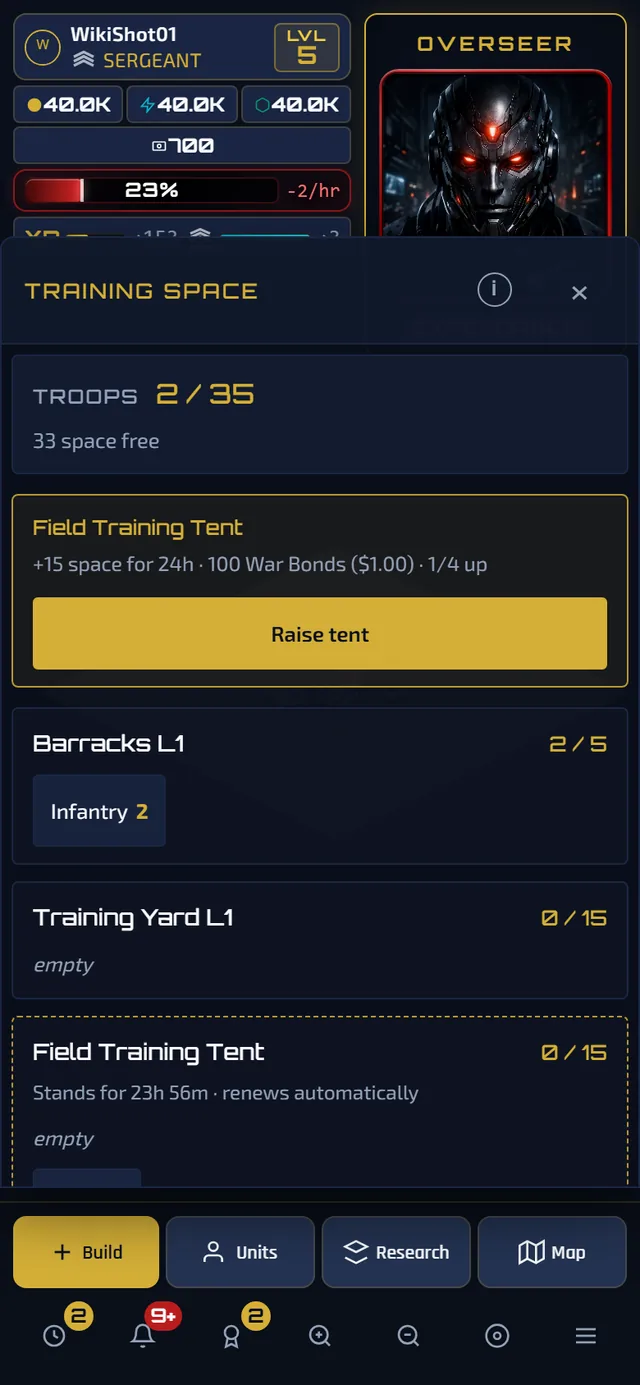
- On the training space screen, where the Field Training Tent has its own block with a Raise tent button and the exact space it would add.
Renting from a row places the tent for you, on the first free square that fits — a player buying one is usually mid-emergency and picking a tile is not what they came for. Move it afterwards if you care where it stands; moving is free.
Renewing
You can renew at any time, and renewing early adds a term to the end rather than throwing away what you have left. Turn on auto-renew and it takes another term when the current one ends, for as long as you have the Bonds to cover it. If you do not, it simply lapses — auto-renew never puts you in debt and never charges a card.
A renewal buys the same term again, at the same rate — renew a four-week lease and you get four more weeks at the half-price-per-day rate, not a single day at the full one. Auto-renew does the same. You can change term when you renew by hand, and whichever you pick becomes the standing term from then on.
The facility card counts down and calls the last hour out. A tent stops providing space the instant its term ends, not when the game next sweeps, so you cannot train into space you have stopped paying for.
When a tent comes down
Its space goes with it. If your remaining buildings can house everyone, the occupants are moved into the free space and nobody is lost. That is the normal outcome and it is worth arranging for. They are rehoused largest-facility-first, into their own pool only — an expiring Field Workshop's tanks are never offered bunks in a Barracks.
Troops that do not fit are stood down permanently. You get back half of what they cost to build, listed as reclaimed salary — half, rounded down, of every resource in their original cost. A transmission tells you how many were lost and what came back.
So a tent lapsing is not automatically a disaster — it is only a loss if you were relying on its space. Keeping one Yard's worth of room spare means a lapse costs you nothing.
Garrisons: you choose who is at risk
Units are housed in a specific facility, and you decide which. Open the training space screen from Manage on the training panel: it lists every facility, what is in it, how much room it has left, and how long a rented one has to run.
Tap a unit stack to move it. A picker opens with a quantity stepper and one button per facility that has room — each showing how much — plus an Unassign option. A facility that is offline for an upgrade is not offered, because it has no space to give.
This is the point of the screen. When a tent lapses, the troops in that tent are the ones at risk — and only those. A lapse never touches a stack housed anywhere else, including the ones under Unassigned, which are simply troops nobody gave a facility to. New units are housed automatically in the facility that made them.
Where being unassigned does cost you is as feedstock: an assembly or a disassembly takes from homeless stacks before it touches a garrison you arranged on purpose. See vehicles.
One kind of stack cannot be moved. A stack marked COMMITTED is locked to a vehicle on the assembly line — it is shown rather than hidden, because it is where your missing space went, but it is not a button until the vehicle lands.
Troops away on an expedition are listed, in whatever facility they marched out of, and you can reassign them while they walk — they never stopped occupying that space, so moving them changes where they will stand, not whether they fit.
The same screen is where you break vehicles back down into troops. That has its own rules and its own way of costing you soldiers — see vehicles.
War Bonds
War Bonds are the game's purchased currency. They are the only thing in War 2050 that cannot be earned: you will never mine them, gather them, research them or be awarded them for a milestone. 100 War Bonds is $1.00.
Bonds cannot buy life, and they cannot buy progression. There is no way to spend money on the clock in the clock, on XP or on a rank. What they buy is time, room and protection:
- A rented structure, at 100 bonds a day for the three production tents. Housing or a production line you have not built yet, or cover for one that is mid-upgrade. That is the rest of this page.
- A forced march, at 50 bonds, which adds half again to a party's speed for the leg it is currently walking. It buys minutes off a journey, and nothing else — it does not speed up the dig and it does not increase the haul.
- A shield, bought by the term from the shield panel. It protects your base from attack, it comes in several terms, and the panel is the only place its prices are quoted — deliberately, because a price printed on a page is a second source of truth for money and this one is read live. Read the panel, not us. See your base for what it does.
- A quicker role swap between two of your base's hexagons. Waiting a full day for one is free; bonds make it land sooner, and the roles panel quotes the price. See your base.
Your balance appears in the resource row at the top of the screen once you have any, and tapping it opens the store.
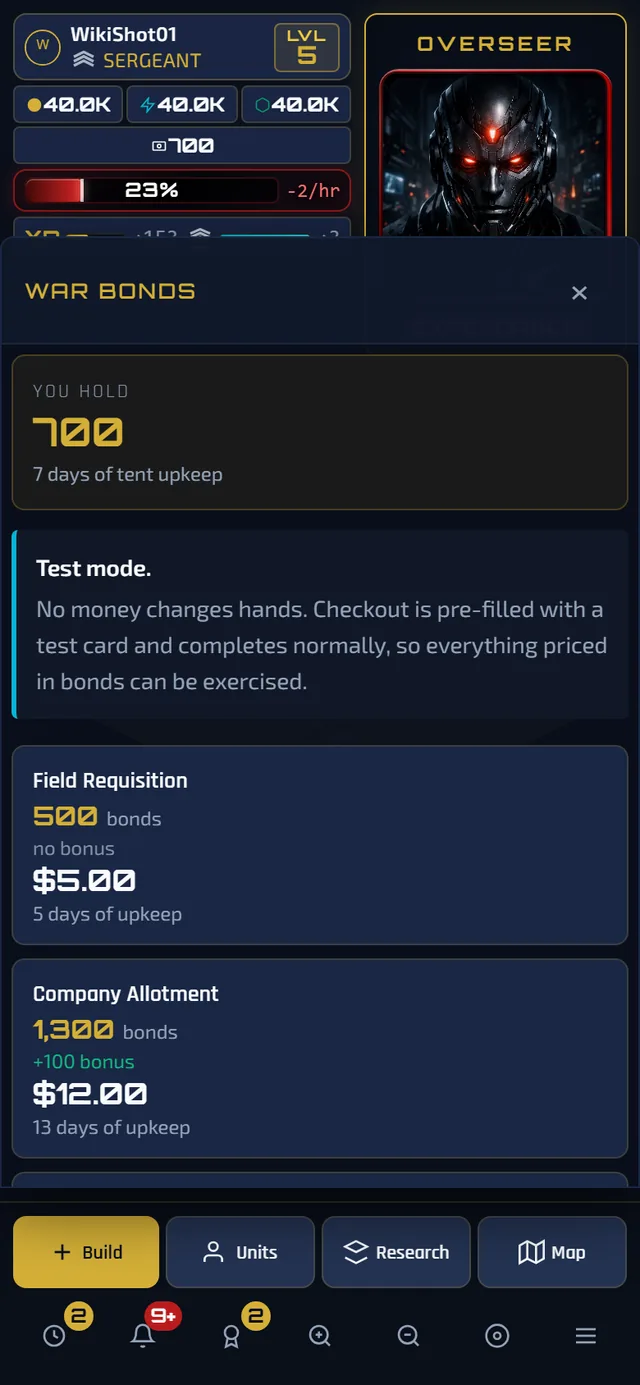
| Pack | Bonds | Bonus | Price | Days of upkeep |
|---|---|---|---|---|
| Section Allotment | 500 | — | $5.00 | 5 |
| Company Allotment | 1,200 | +100 | $12.00 | 13 |
| Regimental Reserve | 3,000 | +450 | $30.00 | 34 |
| War Chest | 7,500 | +1,500 | $75.00 | 90 |
The card details the store displays are a non-issuable test number and the field cannot be typed into. Nothing about a card is ever sent anywhere, and no payment provider is connected. The price list is documented here so the cost of a tent is never a surprise.