Vehicles
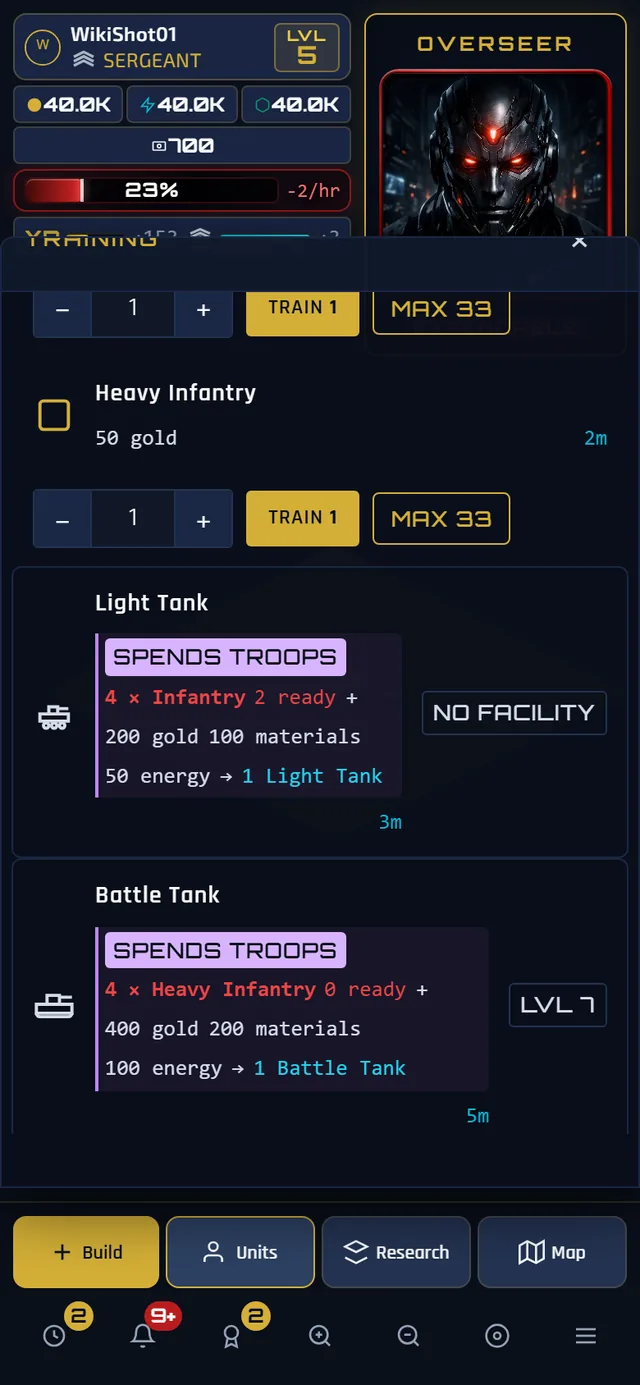
A vehicle is not recruited. It is built out of troops you already have — four soldiers and a pile of resources become one machine. The trade is worth exactly what it eats, moves half again as fast, and takes one parking bay instead of four bunks.
The three recipes
Tables scroll sideways on a narrow screen.
| Vehicle | Level | Eats | Makes | Resources per batch | Time each |
|---|---|---|---|---|---|
| Recon Drone | 3 | 4 Scouts | 2 | 150 gold · 75 materials · 40 energy | 1m |
| Light Tank | 5 | 4 Infantry | 1 | 200 gold · 100 materials · 50 energy | 3m |
| Battle Tank | 7 | 4 Heavy Infantry | 1 | 400 gold · 200 materials · 100 energy | 5m |
It says level 3, but every vehicle is assembled at a Factory, and a Factory needs level 4 — as does the rented Field Workshop that stands in for one. So level 4 is the real gate on all three, and level 3 only means the drone is the first one you unlock once you get there.
Orders are placed in whole batches. Drones come two at a time and the stepper moves in twos; asking for an odd number is refused rather than rounded, because half a recipe has no price.
What you actually get
The bargain is power-neutral and speed-positive. A vehicle's health, attack, defence and carrying capacity are exactly what the troops it ate were worth between them, and its speed is 1.5× theirs. You are not trading power for speed; you are paying resources to compress four bodies into one faster one.
| Made from | Health | Attack | Defence | Carry | Speed | Range | Housing |
|---|---|---|---|---|---|---|---|
| 4 Infantry | 400 | 60 | 20 | 200 | 2 | 1 | 4 bunks |
| → 1 Light Tank | 400 | 60 | 20 | 200 | 3 | 2 | 1 bay |
| 4 Heavy Infantry | 800 | 120 | 60 | 320 | 1 | 1 | 4 bunks |
| → 1 Battle Tank | 800 | 120 | 60 | 320 | 1.5 | 3 | 1 bay |
| 4 Scouts | 240 | 40 | 12 | 100 | 5 | 1 | 4 bunks |
| → 2 Recon Drones | 120 each | 20 each | 6 each | 50 each | 7.5 | 5 | 2 bays |
Speed is the whole point. A Light Tank walks a world tile in 10 seconds against an Infantry's 15; a Recon Drone does it in 4. Since a party moves at the pace of its slowest member, converting your whole party is what actually shortens a trip — one tank among nine infantry changes nothing.
- Speed on the same load. Four Infantry and one Light Tank both lift 200. The tank gets it home in two thirds of the time.
- Range, which is the one stat that is not conserved. A Light Tank outranges the men it was made of, and a Recon Drone sees five tiles. Nothing uses range yet — see the note below.
- Housing that comes from a different pot. Four bunks become one bay, and bays are a separate allowance. This is the part players miss, and it is next.
Health, attack, defence and range are recorded for every vehicle and are raised by military research, but there is no battle system in the game yet — nothing attacks your base and you cannot attack anyone else's. Until that changes, the two numbers that decide whether a conversion was worth it are speed and carry.
Vehicle bays are not training space
Troops are housed in training space; vehicles are housed in vehicle bays. The two pools are completely separate and neither can ever spend the other. The Units panel shows them as two boxes side by side for exactly this reason.
| Building | Level 1 | Level 2 | Level 3 | Max you can build |
|---|---|---|---|---|
| Factory | 5 | 8 | 16 | 2 |
| Motor Pool | 15 | 30 | 60 | 4 |
The Factory carries a handful of bays as a courtesy, exactly as a Barracks carries a handful of bunks: enough to park what you have just learned to build, so unlocking vehicles does not immediately strand you behind a Motor Pool you cannot afford. The Motor Pool is the scaling lever, and because its bays double per level, upgrading one is always worth more than a second Motor Pool at the same tier costs.
- A full Training Yard does not stop you building a tank. That is the point of the separation, and it is checked that way on purpose.
- An empty Motor Pool does not let you train more infantry. The same rule in the other direction.
- Vehicles on the assembly line already occupy a bay, from the moment you place the order. You cannot queue past your bay count.
- A building being upgraded provides nothing while the upgrade runs — bays included. Upgrading your only Motor Pool costs you its 15 bays for the duration.
The troops are locked, not spent
This is the rule that surprises people, and it is deliberate. When you place an assembly order the soldiers are not destroyed. They stay exactly where they are standing, marked COMMITTED in the training-space screen, until the vehicle is delivered.
What that means while the order is running:
- They still take up their bunks. You cannot train replacements into the space, because the space has not been given back. It is handed over only when the vehicle comes off the line.
- They cannot march. A committed stack is invisible to expeditions — it will not appear as available to send.
- They cannot be moved between facilities. The chip is shown, so you can see where your missing space went, but it is not a button.
The order confirmation says so in as many words: the troops are committed to it and still take up training space until it lands.
One line at a time
A Factory runs one order at a time, exactly like a Barracks. Order three Light Tanks and it is one nine-minute job; you cannot start a second batch at the same Factory until it finishes. If every Factory you own is busy, the row says BUSY with the wait on it.
There are two ways past that: build the second Factory the cap allows, or rent a Field Workshop — a canvas assembly line that stands the moment you pay for it. The offer appears on the blocked row itself, labelled RENT WORKSHOP with its price in War Bonds. See training space.
Cancelling an assembly
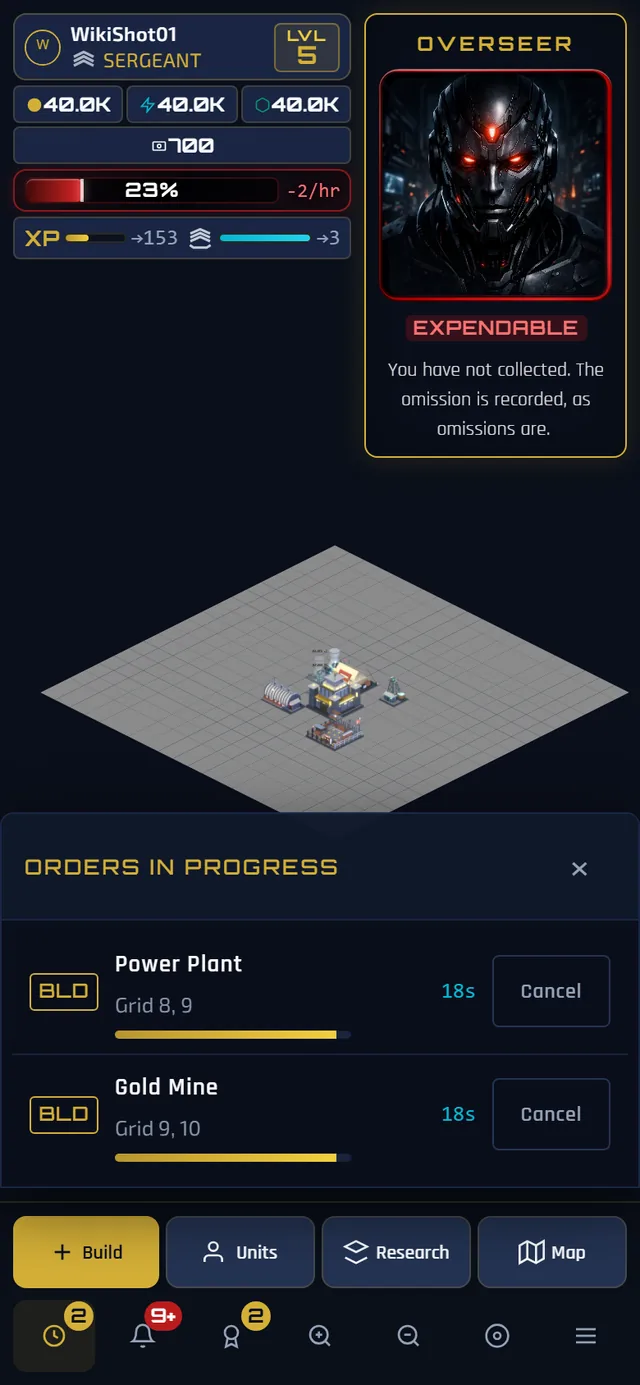
Cancelling a vehicle order releases every committed soldier, unharmed and back where they were standing — and refunds none of the gold, materials or energy. This is different from every other cancel in the game, which returns half of what you paid.
The asymmetry is the point rather than an oversight. The soldiers were reassigned to a workshop, not killed, so handing them back costs nothing and makes a mis-click recoverable. The materials were cut, welded and spent, so they are gone.
Because the troops never gave up their housing, a cancel can never leave you over your training-space cap. There is nothing to make room for.
Taking a vehicle apart
A finished vehicle can be broken back down into the troops it was made from. Open the training-space screen, tap the vehicle stack, and the move picker offers Break up N into troops. It is the exact inverse of the recipe — four Infantry out of one Light Tank, four Scouts out of two Recon Drones — and again, no resources come back, so it cannot be run in a loop for profit.
Whole batches only. One Recon Drone is half a recipe; the button names the number it will actually send and disappears below a full batch.
A completed vehicle gave up its soldiers' bunks when it was delivered. Breaking it up creates those soldiers again, and if you have filled the space in the meantime there is nowhere for them to stand. The game tells you exactly how many would be lost before anything happens — "12 Infantry would come back and you have room for 8. 4 would be stood down for good" — and refuses outright unless you confirm it.
Troops lost this way earn no reclaimed salary, unlike the ones stood down when a rented facility lapses. Make room first: free up a facility, or raise a Field Training Tent.
Is a conversion worth it?
Measured against the thing that actually limits you — housing — a vehicle is a large win, and the resource cost is the price of that win.
| Unit | Carry per place | Per tile | Verdict |
|---|---|---|---|
| Battle Tank | 320 | 20s | The best haul per place in the game, and it fixes Heavy Infantry's crawl. |
| Light Tank | 200 | 10s | The all-rounder. Four Infantry's load, in one place, at better than Infantry pace. |
| Heavy Infantry | 80 | 30s | Cheap bulk, but forces speed 1 on everyone with it. |
| Recon Drone | 50 | 4s | Twice a Scout's load per place, and the fastest thing in the game. |
| Infantry | 50 | 15s | Available immediately, 50 gold, decent pace. Your whole early game. |
| Scout | 25 | 6s | Worth building only to convert into drones. |
- Convert whole parties, not stragglers. The party moves at its slowest member's pace, so a tank travelling with infantry travels at infantry speed and you have paid for nothing.
- Build the Motor Pool before the tanks. A Factory's five bays fill immediately, and an order you cannot house is refused with NO BAY.
- The Scout finally has a use. On its own it carries half an Infantry's load for the same price. As drone feedstock it becomes 50 per place at four seconds a tile — the best time-to-haul in the game for a near deposit.
- Do not convert troops you were about to send. Committed soldiers cannot march, so an assembly placed just before an expedition costs you the party.
Odds and ends
- MAX knows all three limits. The button beside the stepper reads MAX 6 and is the largest order you could actually place — capped by resources, by troops standing ready, and by free bays, whichever binds first. It never offers you an order the game will refuse. The hard cap on any single order is 99.
- Only troops standing ready count. Units still in training, out on an expedition, or already committed to another assembly are not available as feedstock.
- Research applies. Assembly is training as far as the game is concerned, so Rapid Deployment and Drone Workcrews cut the build time exactly as they cut a Barracks batch. See research.
- XP is paid on the vehicle, not the troops. A Light Tank is 32 XP, a Battle Tank 46, a Recon Drone 18 each — on top of the XP those troops already earned when they were trained. See levels & ranks.
- Vehicles gather like anything else. They join a party from the expedition panel and count toward the same carrying capacity. See expeditions.